
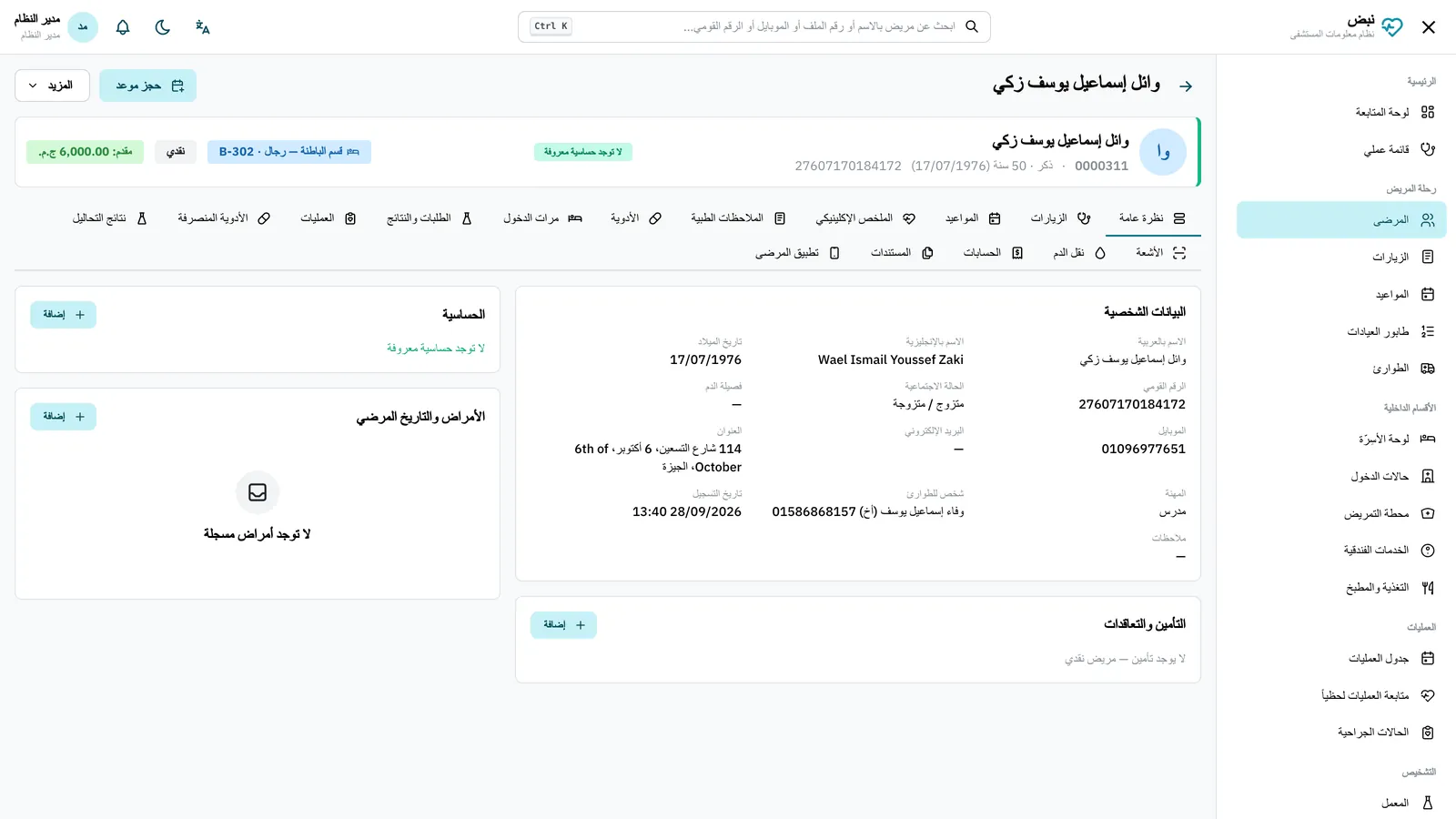
One patient, one record
Registration starts from the Egyptian national ID: birth date, sex and governorate are read from it, and the mobile number is validated. Search works on Arabic names with the usual spelling variations normalised, on the file number, the mobile number or the national ID. Possible duplicates are flagged before a new file is opened, and merging two files is a controlled, audited action. Each patient keeps one medical record number across every facility of the group.
The unified chart
Allergies, problems, alerts and insurance coverages sit on the patient banner, visible from every screen. Below it, the chart has a tab per department, so a doctor opening a file sees previous visits, orders and their results, current medications, surgeries and the billing summary without switching systems.
- SOAP notes with templates and bilingual ICD-10 diagnoses.
- Signed consents, referrals and medical reports.
- Discharge summaries, with an optional AI draft that is off by default and receives de-identified data only.
Orders and results that reach the right person
Lab and radiology orders, order sets and e-prescriptions are entered once and appear in the receiving department immediately. In the laboratory, orders are grouped into tubes and barcode labels print at collection; results are checked against age- and sex-specific ranges and released by a specialist. Radiology reports are written from templates, signed off and linked to the hospital’s PACS viewer. See how this works in lab orders that reach the lab instantly.
Safety checks inside the workflow
- Allergy alerts that include drug classes and cross-sensitivity, plus interaction, duplicate-therapy and high-alert drug checks.
- Witnessed medication administration record (MAR) on the wards and NEWS2 scoring.
- Critical lab results with read-back acknowledgement and automatic escalation when nobody acknowledges.
- WHO surgical safety checklist in the theatre and two-person verification in the blood bank.
Every department on the same record
Emergency with five-level ESI triage and a live board, inpatient wards with a bed board and nursing station, operating theatres with schedules and anaesthesia records, the blood bank, pharmacy and quality all write to the same patient record. A patient moving from the emergency department to a ward to the theatre never gets a second file.
Standards and data exchange
Nabd exposes a read-only FHIR R4 API for patients, practitioners, encounters, observations (vital signs and lab results), conditions, allergies, medication requests, service requests, diagnostic reports and coverages, coded with LOINC, ICD-10 and ATC where configured. Integration keys hold only the read permission they need, can be bound to one facility, and every read is written to the audit trail.
In development, not available yet: an HL7 v2 interface engine, the on-site lab analyser agent and the DICOM Modality Worklist. Nabd links to the PACS viewer but does not store images.
Privacy by design
A consent registry, data-subject requests with due dates, a patient data export, and a breach register with the 72-hour clock are part of the administration screens. Together with the audit trail and the patient access report they are built to support the Egyptian Personal Data Protection Law (PDPL 151/2020) and GAHAR information-management standards.