
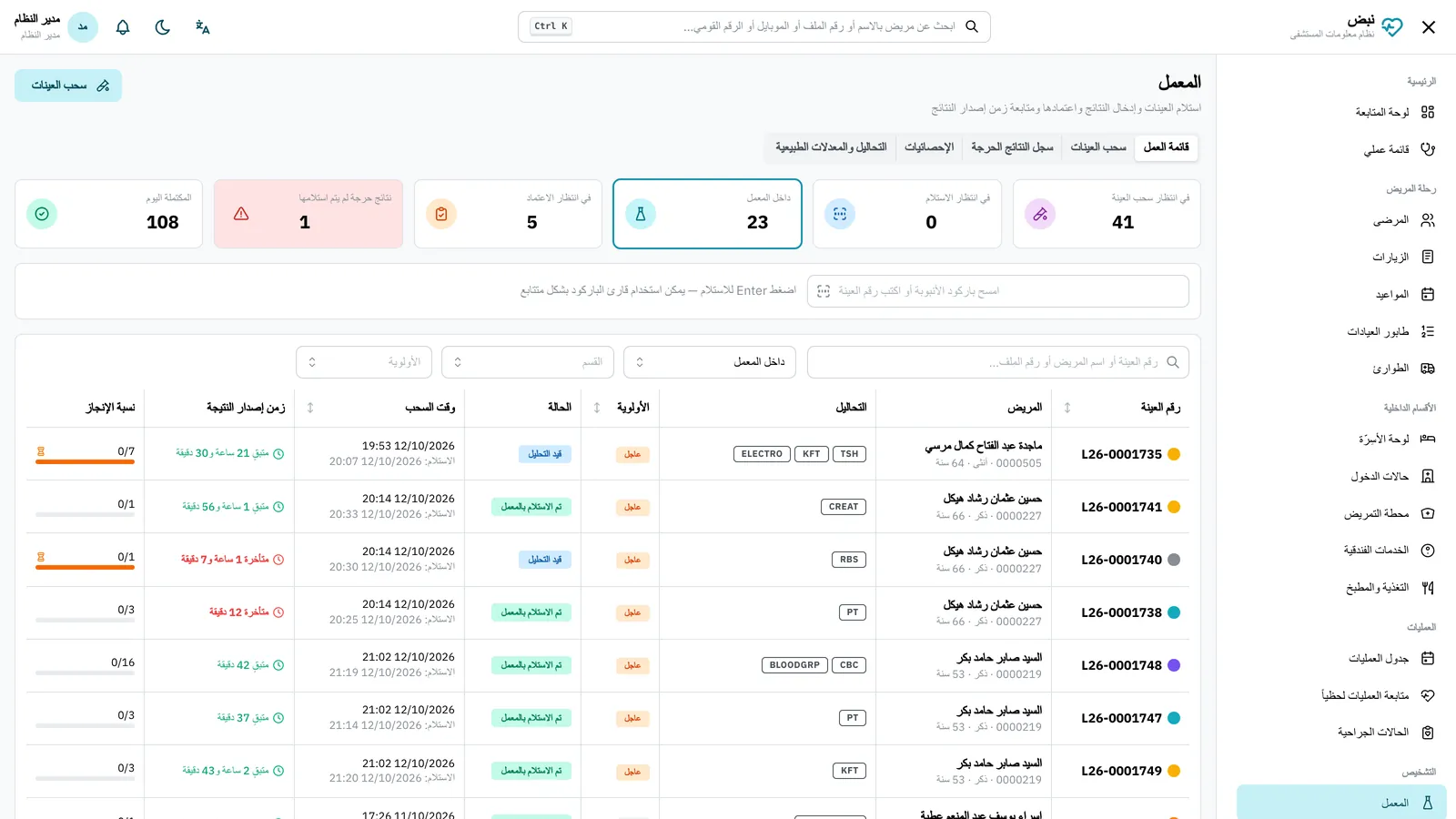
From order to tube: barcodes at collection
When a doctor orders tests, they appear on the collection worklist at once. The phlebotomist or ward nurse selects the patient’s orders and Nabd groups them into one tube per encounter, specimen type and container: a complete blood count and HbA1c share one EDTA tube, liver and kidney panels one serum tube. Each tube gets an accession number and a barcode label printed immediately. Lab reception scans the tube to receive it.
Result entry built for the bench
Technologists enter results in a keyboard-first grid with every parameter of every test on the tube. Values are validated by type and flagged as they are typed; qualifiers such as <0.01, Arabic-Indic digits and Arabic decimal marks are understood. Results are saved as preliminary until a specialist validates them.
Reference ranges and delta checks
- Ranges by sex and age band, using the patient’s age in days at collection; the most specific range wins.
- Critical limits checked first, then low and high flags; qualitative results checked against the expected text.
- The previous released result of the same parameter is shown with its percentage change, and changes above 25% are highlighted.
- The applied range and unit are stored with the result, so later catalogue edits never rewrite history.
Validation, release and amendments
Validation is a separate permission held by lab specialists and supervisors, not by technologists. A released result notifies the ordering doctor. If a released value has to be corrected, the amendment requires a reason, the old and new values are kept, and the doctor is notified again and asked to acknowledge.
Critical results: a closed loop
Numeric values beyond the critical limits are detected automatically; qualitative results can be marked critical by hand. On validation, and immediately on entry for STAT orders, the ordering doctor receives a critical notification that must be acknowledged; for inpatient and emergency patients the ward nurses are notified too. The acknowledgement records who received the result, by which method and whether it was read back. If nobody acknowledges within the time set per facility (30 minutes by default), Nabd escalates to the lab supervisors and the hospital manager. The critical-results log shows every step and the minutes to acknowledge, ready to print for surveys.
Specimen rejection and microbiology
A rejected specimen (haemolysed, clotted, insufficient, mislabelled and other reasons) sends its orders back to the collection list and notifies the ordering doctor and the nurses. Culture tests record organisms, colony counts and an antibiotic sensitivity table that prints as S, I and R.
Analysers and turnaround
Nabd already has a results API for analyser middleware: results arrive by accession number as preliminary values and are validated by a specialist as usual; nothing is released automatically. Turnaround-time and workload statistics feed the lab and management dashboards.
In development: the on-site interface agent that talks to analysers over ASTM or HL7 and forwards their results to Nabd. Until it ships, analyser connections need existing middleware or manual entry.